“उद्धरेदात्मनाऽऽत्मानं नात्मानमवसादयेत्।”
Uddhared ātmanātmānaṁ nātmānam avasādayet — Bhagavad Gītā 6.5
“Let one uplift oneself by one’s own Self; let not the Self be degraded.”

The Ideological and Spiritual Foundation of Kaivalaya Ashram
Yoga is the journey of the “Self”, through the “Self”, to the “Self”.
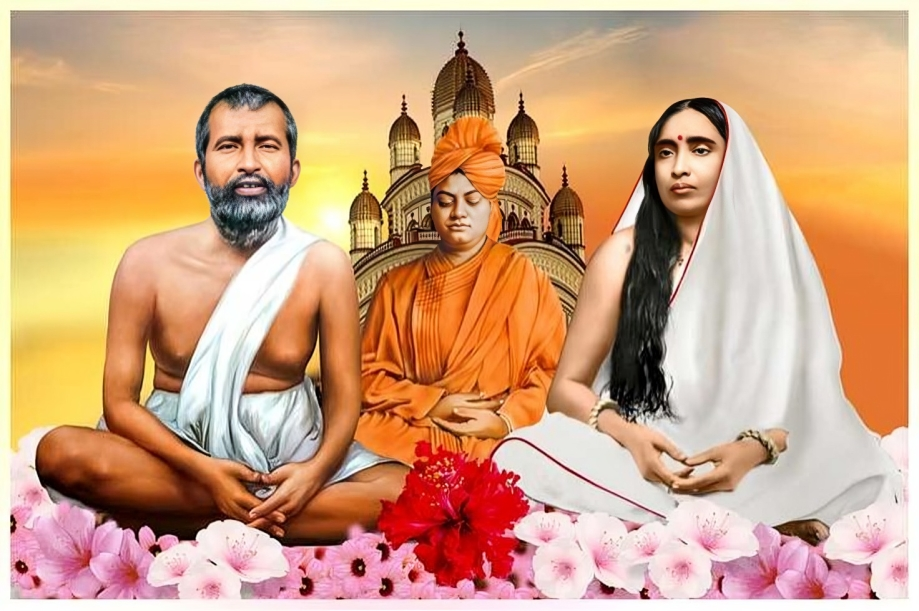
Śrī Rāmakṛṣṇaṁ namāmi nityam, Saradām śānta-rūpiṇīm, Vivekānandaṁ mahā-prājñam, trayaṁ śakti-trayātmakam.
“Salutations to Sri Ramakrishna, eternal and all-pervading;to Holy Mother Sarada, the embodiment of peace;and to Swami Vivekananda, the radiant wisdom of divine power —the three who dwell forever as the guiding light of Kaivalaya.”
In deep reverence to the Holy Trio — Sri Ramakrishna Paramahamsa, Holy Mother Sri Sarada Devi, and Swami Vivekananda, the Administration of Kaivalaya Ashram hereby affirms and certifies that the preceding document, entitled “The Ideological and Spiritual Foundation of Kaivalaya Ashram — The Living Current of the Holy Trio”, authentically represents the core vision, philosophy, and spiritual ideology upon which this Ashram stands.
This declaration reflects the living current of consciousness that flows through the heart of Kaivalaya Ashram — born of Sri Ramakrishna’s realization of the Supreme Brahman, nurtured by the boundless compassion of Holy Mother Sarada Devi, and dynamically expressed through Swami Vivekananda’s fearless wisdom and service. It is through their united presence that the Ashram draws its inspiration, guidance, and sanctity.
The Administration acknowledges this work as the official ideological charter and the spiritual constitution of Kaivalaya Ashram. It shall serve as the guiding framework for all the Ashram’s activities — including spiritual instruction, mentorship programs, retreats, community outreach, and publications. Every teacher, practitioner, and disciple associated with Kaivalaya is thus encouraged to embody these values in thought, word, and action, ensuring that the grace and integrity of the Holy Trio remain alive in every facet of the Ashram’s work.
This ideology is not adopted as a set of doctrines but as a living realization — a continuous remembrance that divinity manifests within the ordinary, and that spiritual life blossoms through purity, service, and self-awareness. Kaivalaya Ashram recognizes Sri Ramakrishna as the embodiment of Parabrahman, Holy Mother Sarada Devi as the ever-living Shakti of compassion and purity, and Swami Vivekananda as the voice of awakened action and fearless truth. Together, they constitute the eternal spiritual trinity guiding Kaivalaya’s mission.
The Ashram administration further certifies that this philosophical foundation has been formally integrated into the curriculum and governance of the Ashram. All training modules, mentoring structures, and community endeavors shall align with this vision, maintaining harmony between realization, love, and expression — the threefold essence of the Holy Trio. In doing so, Kaivalaya Ashram affirms its purpose to serve as a humble instrument of Divine Will, a sanctuary where awareness, compassion, and knowledge converge in daily living.
The Administration of Kaivalaya Ashram expresses its unwavering commitment to preserve the sanctity of this ideology, to protect its authenticity, and to carry its message forward with sincerity and devotion. May this declaration serve as a beacon for all seekers, reminding them that the goal of life is not distant but near — to awaken to one’s own divine essence and live it through service, harmony, and awareness.
In this sacred spirit, the Ashram offers its homage and surrender at the feet of the Holy Trio, praying that their infinite grace continues to illumine every heart that enters the path of Kaivalaya.
1. Introduction — Sankalpa and Source
Kaivalaya Ashram arose from an inner Sankalpa — a settled spiritual resolve to serve awakening in life. The Ashram’s guiding field of grace is the Holy Trio: Sri Ramakrishna (Realization), Ma Sarada (Compassion), and Swami Vivekananda (Action). The Ashram is a living channel — not merely an institution — carrying forward the threefold current: Realization–Compassion–Service.
2. Sri Ramakrishna Paramahamsa — The Manifest Parabrahman
2.1 Uneducated yet Supreme Realizer
Born simple and unlettered; yet manifested the highest Vedantic truth in direct experience. Demonstrates that Brahma-jñāna is experiential, not intellectual.
2.2 Complete Embodiment of the Sixteen Kalās
Sri Ramakrishna manifested the full spectrum of divine perfections (kalās). Kaivalaya Ashram models its inner culture on these perfections. (See full list in §4.)
2.3 Universal Sādhanā — Practiced All Paths
Realized God through Bhakti, Tantra, Vedanta, and mystical experiences across religions; proved that all authentic paths end in one Reality.
2.4 Brahma-Svarūpa — Guru-Tattva in Human Form
He is regarded as Parabrahman manifest — not merely realized, but the living field of Divine consciousness. The Guru principle in Kaivalaya is that same non-personal field — a presence that awakens the seeker.
2.5 Practical Implication for Kaivalaya
Emphasis on anubhava (direct experience), simplicity, and inner purity over scholasticism. Teachers encouraged to transmit presence, not performance.
3. Holy Mother Sri Sarada Devi — The Embodied Shakti of Compassion
3.1 Motherly Presence and Purity
Ma Sarada is the living image of universal motherhood — tender, patient, and unconditionally accepting.
3.2 Shakti as Silent Strength
Her power is inward: endurance, silent transmission, and gentle correction. This is the model for mentorship and seva at the Ashram.
3.3 Ethos of Love and Non-Judgment
The Ashram’s interpersonal climate (training, correction, care) flows from Ma’s example: nurture without attachment, guidance without domination.
3.4 Practical Implication for Kaivalaya
Counseling, correction, and training are to be delivered with motherly empathy; discipline is restorative, not punitive.
4. Swami Vivekananda — Dynamic Vedanta in Action
4.1 Voice and Will of the Movement
Swamiji translated inner realization into a universal mission: practical Vedanta.
4.2 Integration of Jnana–Bhakti–Karma–Raja
He exemplified how knowledge, devotion, work, and meditation form one seamless practice.
4.3 Courageous Service (Sevā) and Social Vision
Spirituality must become social service; the awakened life transforms society.
4.4 Practical Implication for Kaivalaya
Training emphasizes inner practice plus outward service: teachers are instruments of change — calm yet decisive.
5. The Sixteen Kalās — Full List with Descriptions
(Sri Ramakrishna’s perfections; each kalā is a divine quality fully manifest in Him and reflected as values in Kaivalaya.)
Each kalā represents a distinct perfection or luminous expression of Divine Consciousness (Brahma-śakti) that flowered completely in Sri Ramakrishna Paramahamsa. Kaivalaya Ashram recognizes these sixteen kalās as the blueprint for its inner discipline, teacher formation, and spiritual atmosphere — the bridge between Divine Realisation and living practice.
5.1 Shraddhā (Faith)
Essence in Sri Ramakrishna: Unshakable trust in God, Guru, and Divine Providence — a faith that did not waver even in trial.
Reflection in Kaivalaya Ashram: Cultivation of unwavering surrender to the inner Self as the supreme Guru guiding one’s journey.
5.2 Satya (Truth)
Essence in Sri Ramakrishna: Absolute fidelity to truth — He declared that truth and God are one.
Reflection in Kaivalaya Ashram: Commitment to authenticity, honesty, and integrity in teaching, service, and communication.
5.3 Daya (Compassion)
Essence in Sri Ramakrishna: Boundless love and empathy for all beings, seeing every creature as an embodiment of the Divine Mother.
Reflection in Kaivalaya Ashram: Selfless service (Sevā) as a living expression of compassion; service as sādhanā.
5.4 Shama (Peace)
Essence in Sri Ramakrishna: Stillness and equanimity amidst all extremes of joy and suffering.
Reflection in Kaivalaya Ashram: Teachers and seekers maintain calm awareness during all activities and sādhanā.
5.5 Dama (Self-control)
Essence in Sri Ramakrishna: Perfect mastery over the senses; emotions purified into instruments of Divine love.
Reflection in Kaivalaya Ashram: Conscious discipline in speech, conduct, and inner state, ensuring clarity in transmission.
5.6 Titiksha (Forbearance)
Essence in Sri Ramakrishna: Patient endurance through every condition — hunger, mockery, pain, and solitude — without losing faith.
Reflection in Kaivalaya Ashram: Emotional balance and stability in leadership and teaching; acceptance of life’s dualities with grace.
5.7 Uparati (Withdrawal)
Essence in Sri Ramakrishna: Natural detachment from worldliness; spontaneous renunciation born of divine fulfillment.
Reflection in Kaivalaya Ashram: Non-attachment to position, recognition, or praise — remaining inwardly free amidst activity.
5.8 Bhakti (Devotion)
Essence in Sri Ramakrishna: Childlike surrender and ecstatic love for the Divine Mother, expressed through every breath and action.
Reflection in Kaivalaya Ashram: Devotion (bhakti-bhāva) as the foundation of all learning, meditation, and service.
5.9 Jñāna (Wisdom)
Essence in Sri Ramakrishna: Direct realization of the non-dual Brahman — beyond name, form, and distinction.
Reflection in Kaivalaya Ashram: Harmonious integration of Yoga, Tantra, and Vedanta into one living awareness.
5.10 Vairāgya (Renunciation)
Essence in Sri Ramakrishna: Freedom from ego and attachment; unaffected by possessions or praise.
Reflection in Kaivalaya Ashram: Simplicity and inner renunciation; detachment as a natural expression of realization.
5.11 Karuṇā (Grace)
Essence in Sri Ramakrishna: Endless forgiveness and unconditional love, blessing even those who misunderstood Him.
Reflection in Kaivalaya Ashram: Mentorship guided by empathy; correction delivered with compassion and dignity.
5.12 Maitrī (Friendliness)
Essence in Sri Ramakrishna: Universal friendliness; He embraced all seekers, regardless of path or belief.
Reflection in Kaivalaya Ashram: Spirit of brotherhood, inclusion, and unity in sangha — beyond division of caste, creed, or gender.
5.13 Kṣamā (Forgiveness)
Essence in Sri Ramakrishna: Complete absence of resentment; His heart was incapable of anger.
Reflection in Kaivalaya Ashram: Gentle correction in teaching; forgiveness as strength and moral example.
5.14 Ānanda (Bliss)
Essence in Sri Ramakrishna: Perennial joy arising from union with the Divine — His laughter was the sound of realization itself.
Reflection in Kaivalaya Ashram: Joyful, meditative presence in teaching and work; celebration of the Divine in life.
5.15 Śakti (Divine Power)
Essence in Sri Ramakrishna: Mastery over all Yogas and Shaktis; the awakened Kundalinī manifesting spontaneously in compassion and guidance.
Reflection in Kaivalaya Ashram: Conscious use of awareness to transform energy; empowerment through stillness, not control.
5.16 Sampūrṇatā (Wholeness)
Essence in Sri Ramakrishna: The complete manifestation of Parabrahman — the union of the finite and infinite in perfect harmony.
Reflection in Kaivalaya Ashram: The state of Kaivalya — realization of Oneness beyond form, function, or identity.
5.17 How Kaivalaya embodies the kalās
Each kalā becomes a training focus: humility exercises (śraddhā), truth practice (satya), seva rotations (dayā), silence periods (śānti), etc. The teacher’s formation aims to cultivate as many kalās as possible in balanced harmony.
6. Integration: Yoga, Tantra, Vedanta — The Ashram’s Practical Sādhanā
6.1 Yoga — Daily disciplines for mind-body awareness (asana, breath, meditation).
6.2 Tantra — Transformation and purification of subtle energies; respectful, symbolic practices to uplift life force into awareness.
6.3 Vedanta — Inquiry into the Self; sustaining the non-dual view in daily life.
6.4 Synthesis in Practice — Sessions and teacher training integrate silence, energy practice, and inquiry: a practical blueprint aligned with the Holy Trio.
7. The Guru-Tattva and Lineage
7.1 Guru as Field of Consciousness — Not personality worship, but recognition of the guiding presence that awakens inner knowing.
7.2 Transmission through Grace — The Ashram honors grace received from the Holy Trio and encourages surrender plus clear inner practice.